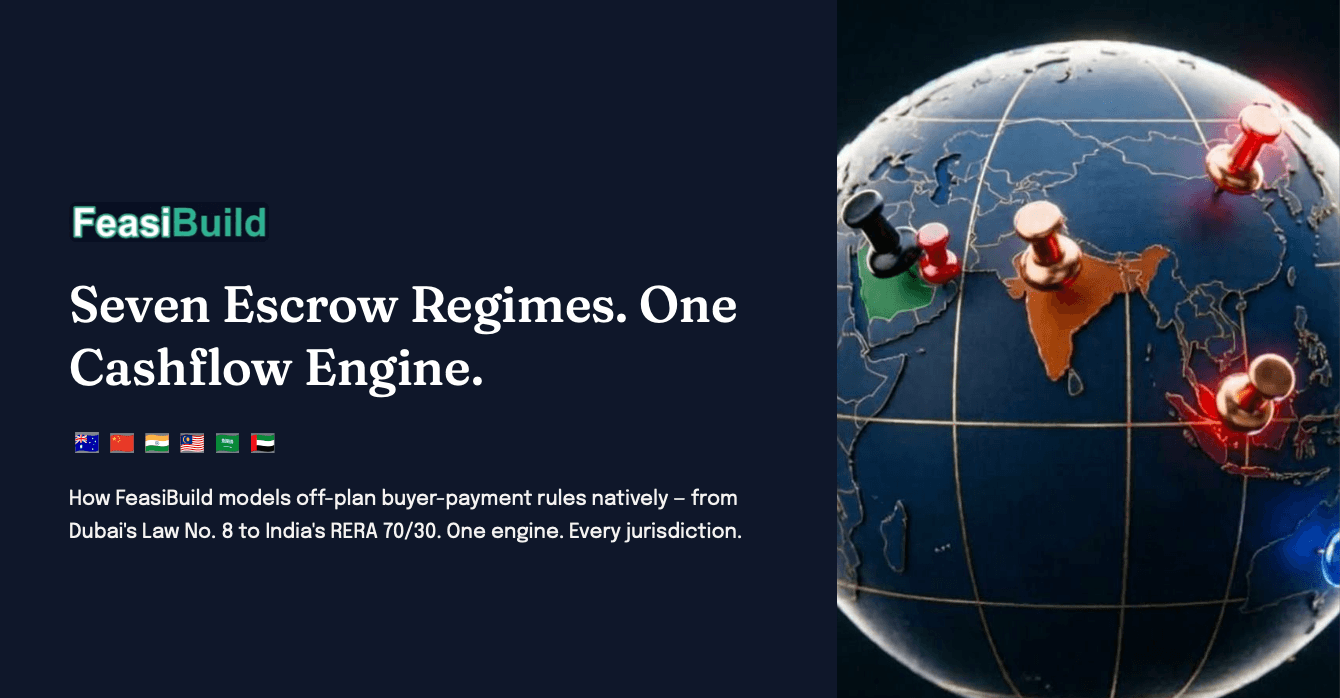
Seven Escrow Regimes. One Cashflow Engine.
Seven escrow regimes. Six countries. One cashflow engine. Most proformas treat off-plan buyer payments as a single inflow line — but every jurisdiction runs its own legal machine. Here is how each one works, and how FeasiBuild models it natively.
Australia — 10/90 Rule
10% deposit at contract, 90% at completion. No project escrow — the deposit is held under state conveyancing trust rules, and the developer carries interest on equity until settlement.
- Governing law: Conveyancing Act 1919 (NSW) · Property Law Act 1974 (Qld) · Sale of Land Act 1962 (Vic)
- Retention: none — no escrow account exists
- In FeasiBuild: 10/90 timing + interest carry; splits editable (20/80, 30/70)
China — Closed-Loop Escrow Rule
Pre-sale proceeds enter government-supervised bank accounts; withdrawals are ring-fenced to construction of that project and released node by node.
- Governing law: Urban Real Estate Administration Law (PRC) · MOHURD Measures · municipal pre-sale funds supervision measures
- Retention: 3% of building works retained from the main contractor for 24 months post-completion
- In FeasiBuild: node-gated releases; zero free cash before certification
India — Proportionate Escrow Rule
70% of every buyer payment is locked in the designated account; 30% is immediate free cash. Withdrawals equal certified completion % × permitted cost, and the lender sweep is locked ON.
- Governing law: RERA 2016 s.4(2)(l)(D) & s.4(3) · State RERAs (MahaRERA, TS RERA…)
- Retention: none — the five-year structural defect liability is a separate legal obligation
- In FeasiBuild: 70% split and sweep locked for India; editable elsewhere
Malaysia — Progress Drawdown Rule
Payments enter the statutorily controlled Housing Development Account; withdrawals only per certified Schedule of Progress stages.
- Governing law: Housing Development (Control and Licensing) Act 1966 (Act 118) + Regulations 1989 · KPKT
- Retention: 5% of GDV — 2.5% released after 8 months, remaining 2.5% after 24 months
- In FeasiBuild: stage-based drawdown curve, native
Saudi Arabia — Milestone & Retention Escrow Rule
Payments enter supervised escrow; certified milestone releases apply with a 20% completion floor (locked), and the lender sweep is locked ON.
- Governing law: Off-Plan Sale & Lease Law + Implementing Regulations (Wafi programme) · REGA
- Retention: 20% completion floor (locked) + 5% held for 12 months after completion
- In FeasiBuild: floor and sweep locked for KSA
UAE · Abu Dhabi — Project Guarantee Account Rule
Buyer payments enter a project guarantee account; developer access only against certified project progress.
- Governing law: Abu Dhabi Law No. 3 of 2015 · DMT — Real Estate Regulatory Committee
- Retention: 5% held for 12 months after project completion
- In FeasiBuild: native preset in the cashflow engine
UAE · Dubai — Staged Escrow Rule
Payments are locked in project escrow, released at certified construction milestones, with retention held to handover.
- Governing law: Law No. 8 of 2007 · Dubai Land Department (DLD) / RERA
- Retention: 5% of GDV held for 12 months after completion
- In FeasiBuild: milestone releases + retention, automatic
Everywhere Else
Market not on the list? Pin-drop any country: choose the No-Escrow Rule, or adopt and edit any of the seven regimes — split %, certification cadence, sweep, retention, horizon. The mechanism is not a country label.
Run your first study free on the Explorer tier — and watch your jurisdiction's rules drive the cashflow. feasibuild.app
Slide deck
Download the slide deck (PDF)Run this analysis yourself — first report free at feasibuild.app
Start your first reportRelated posts
Why Standard Templates Fail in Australia
Most feasibility models assume standard progress payments. In Australia, off-the-plan sales run on 10/90 — and that difference can quietly destroy your project's cashflow.
19 Oct 2026 • 2 min read

Why I Charge $99 for Lifetime Access — Instead of $500/Month
Two traps own this industry: the consultant ransom and the SaaS subscription. Here's the pricing philosophy behind paying once, owning the engine, and never being billed for silence.
19 Oct 2026 • 2 min read
A User Asked Me to Keep His Name Secret
When a user refuses to give a testimonial because they don't want competitors knowing their edge, you know the tool works.
24 Sep 2026 • 2 min read