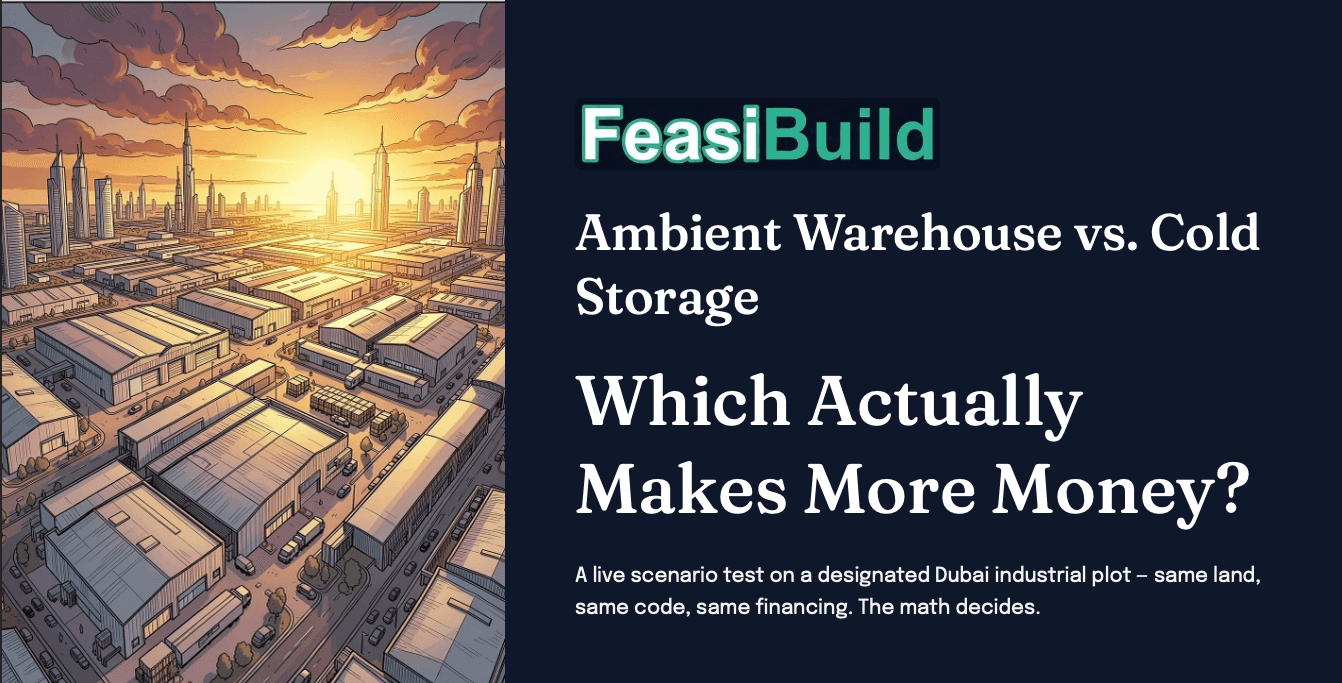
Ambient Warehouse vs. Cold Storage: Which Actually Makes More Money?
In the UAE, the master developer dictates your land use. Your job as a developer is to figure out how to maximize the yield within the permitted use and the plot's building code.
This week, I ran a live scenario test on a designated Dubai industrial plot using FeasiBuild to see which product format actually penciled out best:
- Scenario A: Grade-A Ambient Logistics Warehouse
- Scenario B: Chilled / Cold Storage Facility
I kept the land cost, plot size, and financing terms identical. Only the product format changed.
Scenario A: Grade-A Ambient Logistics Warehouse
- Lower capex — standard MEP fit-out, no refrigeration infrastructure; construction costs stay lean from day one
- Faster build timeline — simpler systems mean shorter construction periods and earlier lease-up
- Lower peak equity — less capital tied up during construction; the loan drawdown curve stays manageable
Scenario B: Chilled / Cold Storage Facility
- Massive rental yield — cold storage commands premium rents; the yield advantage over ambient is significant
- Brutal MEP costs — refrigeration plant, insulated panels and specialized fit-outs hammer the capex budget
- Higher peak equity — heavier construction loan drawdowns spike the interest reserve; cashflow pressure is real
The Results in 30 Minutes
Cold storage wins massively on rental yield… but the ambient warehouse crushed it on Development IRR and required far less peak equity. Refrigeration capex and MEP fit-outs are brutal on the cashflow.
The Kicker: Automated Loan Drawdown Modeling
FeasiBuild didn't just compare static returns — it automatically adjusted construction loan drawdowns and milestone-based cashflows for the heavier MEP costs in the cold storage scenario, surfacing exactly when the interest reserve would peak.
The result: a precise view of when and how much equity each scenario demands — not just what the IRR looks like on paper.
Highest & Best Use, Master-Planned Edition
You don't guess the format. You let the math prove it.
In master-planned markets, highest and best use analysis isn't about rezoning — it's about stress-testing every permitted product format against real construction costs, financing structures, and lease assumptions.
- Same plot — identical land cost & building code
- Different formats — ambient vs. cold storage
- One winner — the IRR and equity story decides
Run Your Own Scenario in 30 Minutes
FeasiBuild automates the highest and best use work that institutional developers and lenders need — from construction loan drawdowns to development IRR — without a spreadsheet in sight.
- Try the free Explorer tier — run your first scenario at no cost, and see how the math works before you commit
- Lifetime access from $99 — full modeling power for a single investment; no subscription, no surprises
Slide deck
Download the slide deck (PDF)Run this analysis yourself — first report free at feasibuild.app
Start your first reportRelated posts
How agents win landowner mandates in 2026
The market has shifted. The agents who close exclusive mandates aren’t the ones with the flashiest decks — they’re the ones who walk in with numbers on the table.
22 Aug 2026 • 6 min read
I Ran a Stress Test on a 200-Unit Residential Deal — Here's What Happened
An 18% base IRR on a 200-unit Malaysian residential project. Two 5% assumption shifts — price down, costs up — and the margin was gone. What the tornado chart saw coming.
19 Oct 2026 • 2 min read

Are You a Valuer, or an Excel Mechanic?
Most valuers and consultants are secretly overworked Excel mechanics. Here is how to get your weekends back and explode your margins.
24 Sep 2026 • 2 min read